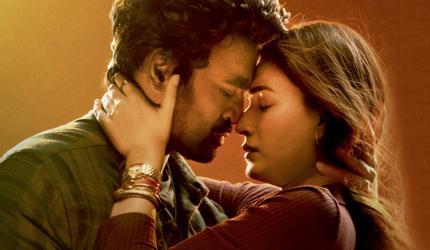
Tere Ishk Mein is a disservice to brilliant actors like Dhanush and Kriti Sanon, who have poured their heart and soul into their performances in a story that fails to honour its characters, notes Divya Nair.

Once in a while, we come across characters that are totally negative, maybe unfit for love. Like, if you meet them in reality, you may not even want to have a conversation. But in Aanand L Rai’s films, they end up being celebrated as heroes.
For instance, Raanjhanaa‘s Kundan would easily be dismissed, ignored maybe even punished for being a relentless stalker in real life.
But in the film, you forget who he is, and just can’t hold back your emotions when he sacrifices himself for his childhood love Zoya.
What is love? Sacrifice? Selflessness? Or Obsession?
This is a theme often exploited by filmmakers. But trust Rai to take obsessive romance to the next level and celebrate it with sacrifice and self-destruction.
His latest installment Tere Ishq Mein banks on the success of Raanjhanaa and aims to recreate the same magic onscreen with a new pair and a new story.
Replacing Kundan and Zoya with Shankar (Dhanush) and Mukti (Kriti Sanon), Rai tries to sell you a love story between a reckless, aimless, angry young law student and an ambitious PhD aspirant.
It’s love at first sight, head over heels in love for Shankar.
For Mukti, it’s just work, a project where Shankar is the subject for her thesis.
Despite the differences, and though aware of their limitations, they walk into the very risks destiny has laid out for them, only to ruin each other.
All in the guise of mistaken and misunderstood love.
The outcome in TIM is a bit fiercer than what we saw in Raanjahanaa.
Here, you get an obsessive love story that is less purposeful than Arjun Reddy and less impactful than Raanjhanaa.
The first half cooks like slow meat, while you keep waiting for the characters to wake up and give you a taste of their twisted, half-baked realities simmering beneath them.
Despite the intensity of the characters, blame it on the sincerity with which Dhanush portrays Shankar, you are forced to lean in to his version and justification of why his illusion of love and sacrifice matters more than his lack of acceptance and tolerance for rejection.
Kriti has to scream her lungs out, try the UPSC trick and take him on an unnecessary guilt trip instead of simply rejecting our hero and moving on.
There is one particular dialogue by Kriti, where she tries to make an important point about perspective how girls grow up longing for their perfect Prince Charming and end up losing sight of the real deal in front of them. The dialogue is written so poorly you’d end up laughing and trolling instead of feeling the punch it desperately aims for.
Aanand Rai has also tried to add a lot of variety to bring in the emotional depth.
There is the rigour of UPSC, the dead father’s sentiment, the Air Force ambition, and patriotism and what not. Sadly, none of it is explored well.
What actually worked for me is the few minutes of monologue by Mohammed Zeeshan Ayub (in a guest appearance reprising his role from Raanjhanaa) — it’s powerful, necessary and convincing.
When he repeatedly asks who is Shankar mourning for, his know-it-all smile and wake-up speech… every word of it will pierce through your broken heart, cutting it deeper, like a sense of self-realisation.
When he tells Shankar, whatever you do, ‘mukti nahi milegi‘, you can’t agree more.
It’s easily, the best written speech to tell a young boy raised by a single father, of mourning over and accepting two different deaths — one of a lover, and also of a father.
What I liked about TIM is how it is also a tale of love by two different fathers who are defeated by their children’s ill-fated love.
The second half puts you through a lot of melodrama, but quietly makes you realise that this is probably the last generation that has tested its love so fiercely, fought and guarded it.
The current or next generation may not have the patience to endure what Shankar or Mukti has.
The lack of physical chemistry between Shankar and Mukti is probably intentional which it tries to compensate with emotional intensity.
Dhanush is phenomenal as the sincere, heartbroken, one-sided lover. This time, the director has cleverly used his Tamil to elevate some of his most emotional scenes.
Would this story have worked better in Tamil or any Southern language? Yes, yes, yes.
Why doesn’t it work for Bollywood? Because it is unfair, illogical, and too dramatic.
It hurts when Shankar asks Mukti: Why didn’t you tell me before (that you didn’t love me)?
It hurts when he asks: Did you ever love me? Even for a day?
Everything that Mukti says goes tone deaf because in that moment, you’re only invested in Shankar’s anger and aggression because it feels more sincere and raw.
We have seen Dhanush channel his rage and vulnerability so convincingly that Kriti’s obsession doesn’t match up to Dhanush’s.
The supporting cast, including Prakash Raj and Tota Roy Chowdhary do their best to cement their emotional core as parents.
But there is no strong side-kick as Bindiya or Murari, who would counsel for restraint and wisdom, which is probably why the film fails to anchor the impact it intended for.
Overall, the story isn’t convincing enough, so the sacrifice feels more forced than earned so much that it lacks the pain that would make you ache along.
It is a disservice to brilliant actors like Dhanush and Kriti who have poured their heart and soul into their performances in a story that fails to honour its characters.
In the end, Tere Ishk Mein cruelly reminds you that in a world that rewards the sacrifice of Vanraj (in Hum Dil De Chuke Sanam) over Sameer, Kundans and Shankars are doomed to die a thousand deaths trying to prove their love.
If you have experienced heartbreak, Tere Ishk Mein may remind you how fragile, unrequited love can shatter even the strongest of hearts.
Tere Ishk Mein Review Rediff Rating: